Teaching Cairn to Kids
Introduction
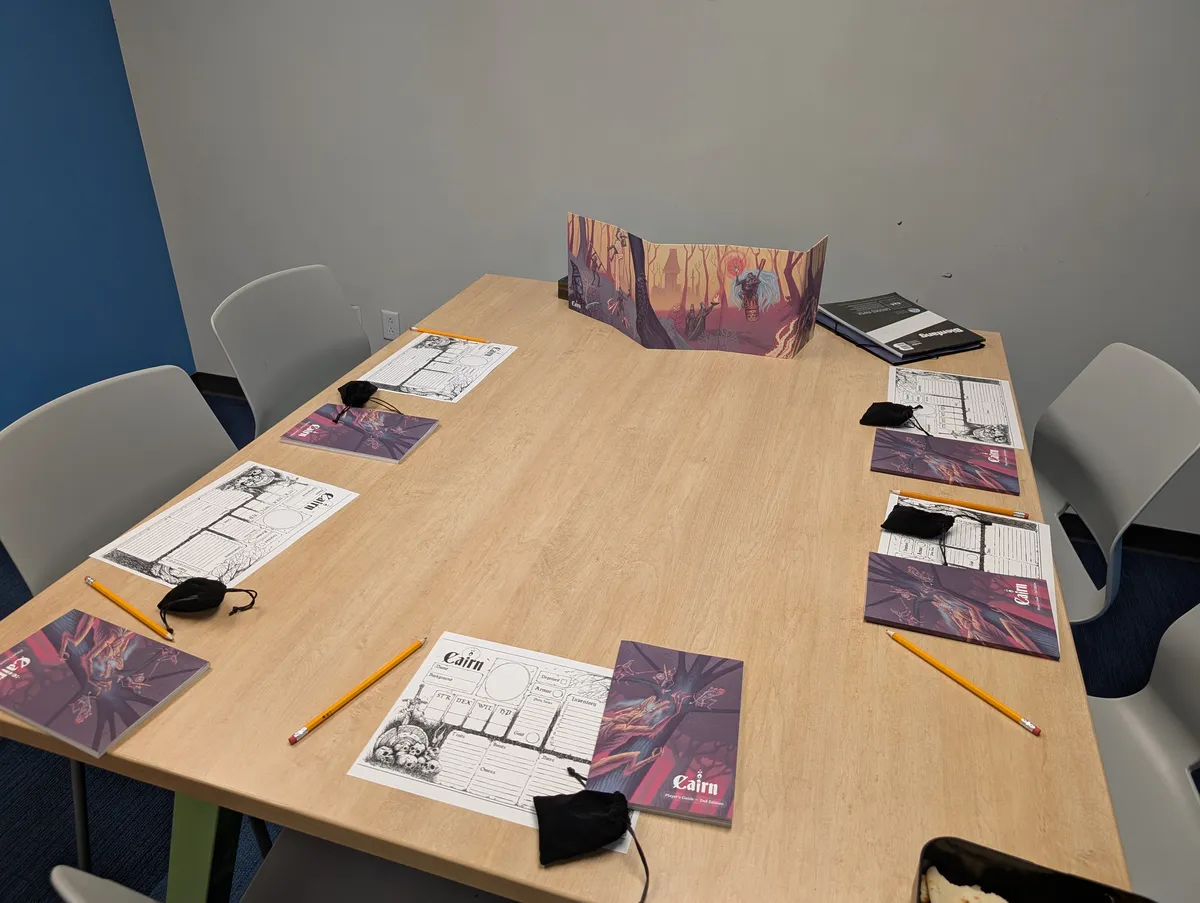
For the past three years, I have run Cairn Second Edition for the students of my middle school. Each year I have run a different type of module: My first year I ran the excellent sandbox adventure The Black Wyrm of Brandonsford, my second year I ran the very non-traditional adventure site The Waking of Willowby Hall, and this year I ran a playtest for my dungeon: Stag Lord's Sanctum.
I have learned some lessons along the way about introducing new players to the OSR play style in general and to Cairn specifically. While most of what I discuss here concerns running Cairn for young people, I have found that most of what I am about to elaborate on was true of the adults I have onboarded as well. Students that have little exposure to TTRPGs, like their adult counterparts, often acclimate the fastest to the play style. Meanwhile, some of the students came to my table having only been exposed to 5e, and thus had a very narrow conception of what a roleplaying game should be.
It is my hope that if you are planning on running a new Tabletop RPG for someone, you can glean something of value from my success and failures.
Goals
When I'm going to run something for someone, whether it is a campaign for some friends or a one-shot at a convention, I always start by deciding what goals I have for the game and tailor my approach to that. For a convention game with people already familiar with Cairn I might skip character creation if my primary focus is on playtesting new material, but since my sessions from year to year are often at least one player's introduction to TTRPGS, I have approached the last three years with the following goals in mind:
- Show students that there are other ways to play TTRPGs besides using the methods and systems they might be familiar with.
- Give them as faithful an experience with the OSR play style as possible with my preferred system: Cairn Second Edition.
- Show them how easy it is to get a game off the ground compared to what they might think or be used to.
- Have them start running their own games.
To my knowledge, I have only succeeded in three out of my four goals, but I live in hope that one day one of them will ask me for help starting up their own campaign.
Starting the Game
Philosophies and Mini-Session 0’s
I always start by going over the Design Philosophies of Cairn that are listed in the Player's Guide, the Principles for Players, and then we do character creation. I prefer doing the full character creation process with students because I want them to see how easy it is. The ones that have played 5e before see character creation as a creative but onerous process, and with Cairn 2e you roll on a few tables and are off to the races.
I like to roll Bonds and an Omen, even though they aren't necessary for one-shots and campaigns encompassing single adventures, because they let me stretch my improv muscles and weave together a brief backstory for the PCs that gives them a reason to brave the unknown. It’s a lot like doing a session 0, but it takes less than 10 minutes once you get the hang of it. I pilfered this technique from my friend and collaborator Yochai Gal after observing it at a convention game he ran, but if you don't feel comfortable being put on the spot like that a decent hook from the adventure module you are running should work.
Taking the Plunge
I've heard some people think it is a good idea to ease people into the OSR Play Style. Let people re-roll stats, pick the Background they feel drawn to, be a cool fantasy race, etc.
I disagree.
I want my players to have none of the trappings they associate with a traditional fantasy game. That means no familiar fantasy racial options, no stat arrays, and the only things making decisions during character creation are the dice.
Many of my players like video games, and I often compare Cairn to a Roguelike where you have to survive by your wits and play the hand you are dealt. Like most human beings, my players like to feel clever and appreciate a challenge, so framing it this way gets most everyone on board quickly.
I will admit that I have had a student or two grumble about the lack of choice in character creation, particularly around wanting to be an elf or a birdperson or whatever. They get over this really quickly once the adventure starts, and each year has had fewer objections than the last.
Vanilla Extraction
This is less essential when running for students who are new to TTRPGs, but I have found it very useful to cull anything that is heavily associated with vanilla fantasy. The first year I ran, I had a student try to infer the strength and elemental affinity of the titular wyrm of The Black Wyrm of Brandonsford by interrogating an NPC who had encountered it and determining its size and scale color. Clever? Sure. Also a surefire way to have an inevitable clash between expectations and reality at the game table.
So I cut anything out that feels to Vanilla D&D. Goblins become Pooka or Batfolk, NPCs of different traditional Fantasy races often become human, and things that can't be changed like Dragons and Giants have their non-D&D aspects emphasized. I've elaborated on the benefits of this approach before, but I can't stress enough how important I have found this in getting students to jettison their assumptions based on the world of D&D and focused on how the fantasy world their character is in actually works.
It is helpful to have some sort of overarching aesthetic to replace the vanilla with, though. I opt for fairytales, which I'm sure is obvious from my module choices.
Props are Nice, But Not Necessary
When I ran Black Wyrm I drew a whole Wilderness map on a dry erase board so I could really wow students during exploration. When I ran Willowby Hall I printed the whole map out on 11x17" paper, put sticky notes everywhere to conceal room contents, and made a cardboard standee of Bonebreaker Tom. For Stag Lord's Sanctum, I handed one of my players who volunteered a piece of graph paper and explained she would be mapping the dungeon.
And you know what? I got more investment out of that then any other method I had previously used. That dungeon map was claimed by that player at the end of our last session as a souvenir, while Bonebreaker Tom keeps me company on my desk.
Don't be afraid to let them work for it.
Running the Game
Difficulty Levels
This was my second time playtesting Stag Lord's Sanctum, with the first taking place at PAX Unplugged 2025. It's come a long way since its days as a hasty reskin of Barrow of the Elf King that I did on a whim.
It is a challenging module, filled with puzzles, hazards, and dangerous entities that can spell disaster for an unwary party. My playtest group from PAX Unplugged had to flee the dungeon with their objective only partially fulfilled due to the threat to their character's lives.
I've had some people ask me if I change anything or go easy on kids when I run games for them.
The answer is no. I run everything exactly the same. And you know what? The kids do great. My students this year managed to uncover many secrets of the sanctum, rescued people, overcame obstacles, blundered into a terrible bargain but managed to ultimately weasel their way out of it, and destroyed an ancient supernatural threat on their way out.
Start at the Dungeon
The best thing you can do to get kids into the OSR play style is to get them into a scenario that shows the difference as soon as possible, and that means a dungeon. Wandering around a town is fun and all, but when I ran The Black Wyrm of Brandonsford my students didn’t really start seeing the differences from their 5e game until I got them into the Wilderness.
In subsequent years, I have always started them at an adventure site and it gets them to see the merits of the gameplay so much faster.
Transparent Procedures
The second players get into a dungeon I have them establish a marching order, determine who has the light sources, and then explain what triggers a Dungeon Events roll. I don’t bother to tell them what happens when I roll a certain result, but I do give them a rough idea of what sorts of challenges arise when you spend time in a dungeon.
I have heard some players get turned off by this approach because it makes things feel “gamey”, but I have never had that reaction from any player I have onboarded, adult or adolescent. It’s important for players to understand the risks involved so they can make informed decisions.
Humble Origins and Tools of the Trade
Every Cairn character has a Background, which is essentially the profession they occupied before they took up (or had forced upon them) the call to adventure. While Backgrounds aren't nearly as restrictive as classes, they do suggest things that a character knows and has experience doing.
I'm a pretty big proponent of Chris McDowall's ICI Doctrine, and so I'm always considering what Backgrounds might have additional information about something that is encountered during the session. If none of the player characters would know something, I'll often point out the types of Backgrounds or NPCs within the game world that would.
I do the same thing with any situations where a specific tool might come in handy: "Sure you can pry that damp-swollen chest open with your dagger, but it'll take a Turn and you might seriously foul your edge. Too bad you don't have a crowbar. You'd make short work of it".
By pointing out to players what their characters lack, they begin to consider what they do possess. Often, they can come up with a more clever alternative with a little bit of lateral thinking.
Combat Avoidance
A big concern I often see with people planning on running Cairn for folks who have never played an OSR game is that they would be likely to engage in combat like it is 5e and be steamrolled. This hasn't been my experience. Once I explained the Philosophies and Principles of Cairn it was quite the opposite.
After all, the grounded nature of the Backgrounds and starting equipment of most PCs emphasizes that they are, for the most part, normal people who are often initially not nearly well-equipped enough to take on dangerous situations compared to a Fighter, Cleric, or Magic User from a more traditional adventure game.
If anything, I would say these two things combined to make my players too scared of combat. My first year group entirely avoided combat, even when it would have likely been to their advantage, and killed the Black Wyrm through trickery and stacking the deck extremely in their favor. My second year group recalibrated because of the addition of a more reckless player, learned the difference between fights that are worth the risk and ones that are best avoided, but ultimately succeeded more through leveraging resources than brute strength. Even my third year group, stacked with five players and two animal companions, grappled with the possibility of using an NPC in their care as a bargaining chip before ultimately deciding that it was worth risking death over doing something so morally reprehensible.
I think this is a hard thing to give concrete guidance on because so much of it will depend on the personalities at the table, but for me it was important to maintain my position as a neutral arbiter. At the end of the day, players at a table will end up teaching themselves the lessons they need regarding the proper approach to combat.
Declaration and Resolution
Speaking of combat, one of the common mistakes I see when people run Cairn (or any Oddlike) combat is not having players declare all of their actions and then you as the Warden resolving them simultaneously. If you let the player with a d8 weapon roll first and they get a 7, then obviously the two other players who were going to attack the same target and only have d6 weapons are going to feel like their time is being wasted. However, if there are four PCs and 2 monsters to deal with, and you don’t know how any of those rolls are going to go until you have committed to a target and rolled simultaneously, there’s a lot more tension that is developed and more tactical considerations at play.
I have found that the same tension can be developed within a Dungeon Cycle by applying the same principle: make everyone tell you what they want to do in a given room and then after they have committed, resolve everything simultaneously. I generally do this in order of logical sequence, so points of interest that are closer and/or interactions that are less complicated are resolved first, but I reserve the right to resolve things in the most dramatic way possible if it is appropriate. There are few things better than watching the faces of players as you resolve the more innocuous actions leading up to the thing that everyone is pretty convinced was a really bad idea.
I suspect this won’t be groundbreaking for a lot of people, but I’ve seen plenty of people not do it and I think it makes all the difference. Dwiz has a great (Bloggies-nominated!) blog post going over the merits of this approach in a lot more detail here.
Ending the Game
Show Impact
When I’m done running a module that isn’t part of an ongoing campaign, whether it is a one-shot or a multi-session endeavor, I generally end things with a denouement of sorts where I explain the long-term consequences of the party’s actions or inactions. I know a lot of people think the OSR is allergic to telling stories, but I only find that is true of pre-planned and collaborative stories rather than ones that emerge from play. If I know players will never get a chance to revisit their characters or the setting, there’s no harm in telling them about the impact their actions will have on the world as a whole.
After all, I think the ability of players to truly make their mark on the world is the thing that best differentiates TTRPGS from any other type of game.
Conclusion
I'm likely preaching to the choir regarding a lot of these items, but I felt compelled to write this post because I keep on seeing people hesitate when thinking about running Cairn for kids, people new to the play style, etc.
I won't pretend that you will somehow convince everyone you run for that the OSR or Cairn is the greatest thing since sliced bread. A couple of my students have still told me they prefer the heroic fantasy of 5e, and that's fine, but every year I have less player turnover than the last.
Don't wait until you are perfectly ready, whatever that means. Buy everyone some dice, print out some character sheets, and read your favorite module a couple of times. Try the things I talked about in this blog post, but don't worry about getting it perfect. Just do your best.
The players will do the rest.