Play Style Preferences: Widdershins Worldbuilding
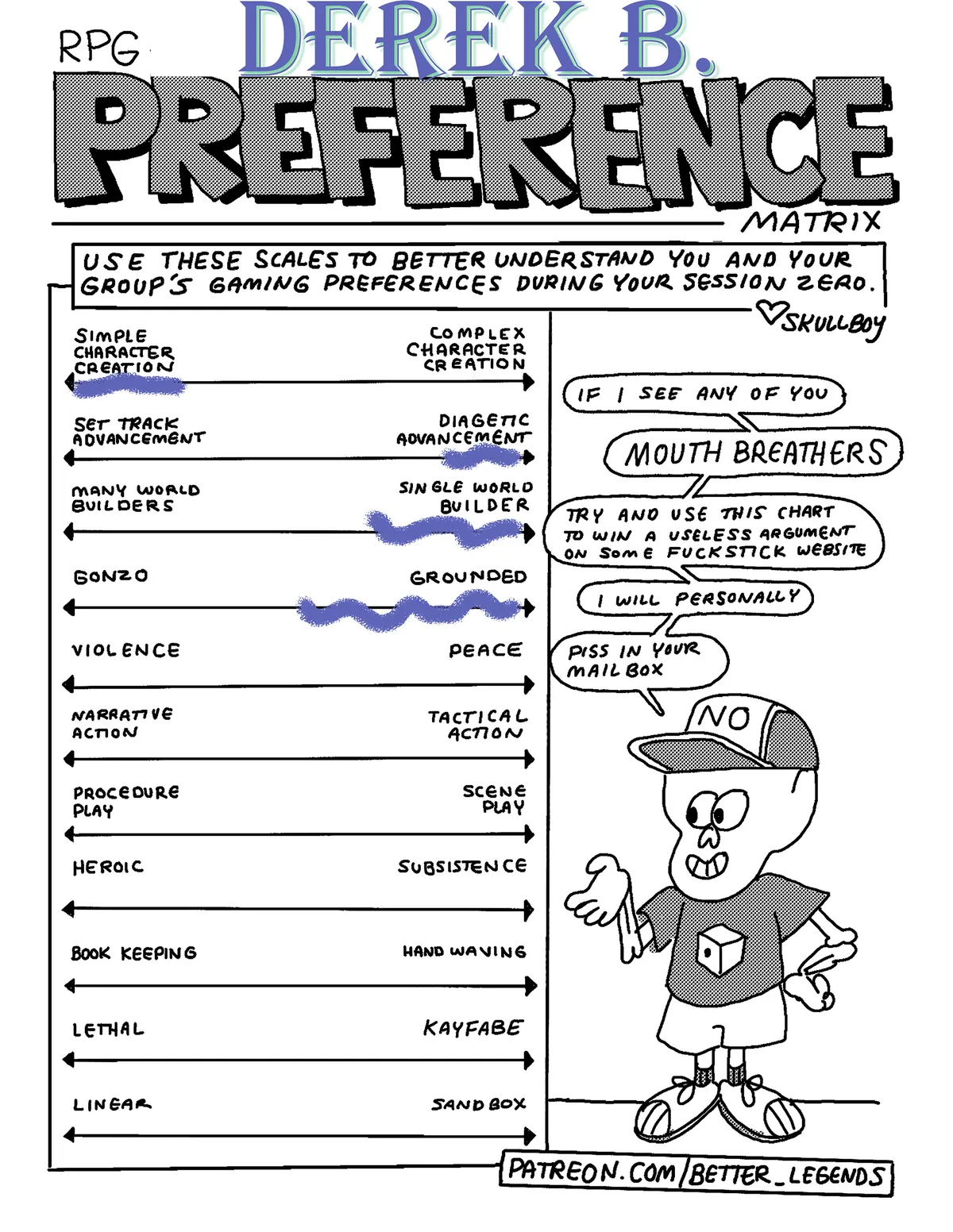
Original image by Better Legends. Used with permission.
Introduction
For the sake of my sanity, I'm going to combine the next two categories together because they both deal with Worldbuilding. The title of today's post alludes to the title of my blog, of course, so I hope everyone will indulge me if I explain why I chose the name Widdershins Wanderings for the humble abode of my digital ink. Anyone with access to a dictionary can discover that Widdershins is an old way to say counterclockwise. What you might not know is that going Widdershins around something is a traditional way to end up in Faerie/Elfland/Otherworld. So Widdershins Wanderings alludes to adventures where you end up in strange places.
This is key to understanding the campaign structure I am proposing in this blog post.
You see, I like weird, idiosyncratic settings that are often the product of a single mind drawing on a particular set of influences. Many of the G+ campaigns of old are perfect examples of this: Gus L.'s HMS Apollyon, Ben L.'s Ultan's Door, and Miranda Elkins's Nightwick Abbey come to mind. These campaigns are legendary within the OSR blogosphere. I was but a mere lurker of our scene back then, but if I can be accused of nostalgia for anything within our hobby it is for that period of time: the OSR was alive with blogs in seemingly constant conversation with one another and wild, insanely creative campaigns were being both run and played by some of the foremost bloggers of the time period.
The interesting thing about that period of time was that characters would often be used in multiple campaigns. People would just hop from one campaign to the next, converting their characters over as necessary from session to session, and the setting itself had to be able to accommodate that in some capacity. I think this makes for an intriguing situation in regards to characters, because essentially any Setting you create has to be built for and accommodate outsiders.
I realized a while back when starting a new home game that if you want a game that embraces the joy of random character generation and has Diegetic Character Advancement, there are a lot of lessons you can learn from these campaigns. You need to consider what in your campaign needs to be Workaday and what needs to be Widdershins.
Lesson #1: Grounded Characters
I think the weirder your setting is, the more grounded your characters should be.
Why? Well, for one, a grounded character is easily comprehensible at the table. You don't have to stop and explain what a Human Fighter is or does in Old School Essentials, a Teamster in Mothership, a Kettlewright in Cairn. At most, you need to see a sentence or two of description and a list of equipment and you can start playing.
You can have weird and fantastical things in your setting, but make that sort of thing rare in character creation. As Ty points out, every group has a baseline they are working with based on the shared understanding of influences that were drawn on during the creation of the setting. The fewer elements of the character that go above the baseline of the group, the more the setting can do so without breaking down the table's comprehension entirely.
A lot of the G+ Campaigns had very limited character creation options. I run Cairn, where the main difference between PCs is their Background. Though many have strange names, they are generally pretty workaday professions at their core. This puts the emphasis on the setting rather than the characters, though there's nothing to stop them from getting weirder as the campaign progresses.
Lesson #1 Addendum: A Defense of Human-Only
I like to have humans as the only playable Species/Kindred/Kith at the start of a campaign, but perhaps not for the reason that you would suspect. You see, any such options have to either be well below a player's baseline (i.e. a generic D&D elf or dwarf) or it requires doing some homework to understand what makes them different from a human. I want players to be able randomly generate and then go, and I also don't want to see a unique kith of a setting reduced to a caricature of a more vanilla species or a human with a rubber mask.
This is an issue I have with a lot of popular OSR games that have really unique settings: Vaults of Vaarn, Dolmenwood, and Break!! all come to mind. Because both the character details and world are likely to be new to players, making a character that is already a part of the setting where the campaign will take place actually caters more to the "Trad" or Original Character (OC) play style that values writing interesting backstories and such rather than my particular play style preference.
Of course, I have workarounds. I can always start a Vaults of Vaarn campaign with a group of True-Kin escaping a failed arcology, a Dolmenwood campaign with PCs being a group from the more mundane outskirts of the Dutchy of Brackenwold, a Break!! campaign with a group of PCs consisting entirely of Dimensional Strays from our world. However, if I had my druthers, and I do whenever I'm homebrewing my own setting, I want a campaign where this is the default rather than one option among many.
It's not that I object to the presence of players taking on the roles of more fantastical denizens of the setting. I just want to hold off on such things until they are more fully immersed.
Lesson #2: PCs as Outsiders
Of course, it doesn't matter how easy to understand a new character is if they are expected to be enmeshed in the setting from the start. I am a big believer in making PCs outsiders in any setting I run a game in. I'm hardly alone in this suggestion: Classic Traveller had PCs as military retirees seeking their fortune in the frontier of space, both Ultan's Door and HMS Apollyon (at least the Flailsnails participants) have players as complete outsiders to the entire plane of existence their PCs find themselves in, and of course there's the classic West Marches campaign premise where players find themselves exploring a long-forgotten borderland.
One reason this is a good idea is that it syncs up character and player knowledge. When the PCs encounter strange white swine with human-like eyes and child-like hands, the player and PC are both clueless. As the player becomes more familiar, their PC can act in a more informed fashion. This prevents a lot of the tedious "Would my character know this?" questions you get when they are actually supposed to be familiar with a setting as a PC but are obviously not as a player.
Another reason I like PCs as outsiders is you can't lean on backstory and have to solve problems through play. Because your PC has no relevant preexisting relationships within the setting, the pros and cons of every NPC and Faction interaction have to be carefully considered. This is especially potent in a setting where there are no clear-cut distinctions between who is good and evil.
Lesson #3: Workaday and Widdershins, Magical and Mundane
In my opinion, there's no point in going to all of the effort of making PCs grounded outsiders to your setting if said setting is by the numbers. I know a lot of people like Vanilla settings, and that is fine, but out of all the pleasures of the OSR I value Secrecy and Discovery most of all. So I want things to be fresh and exciting, weird and wonderful.
I also want things to make sense once you grasp the underlying logic of the setting. People like to abuse the word Gonzo a lot, applying it to any setting that has non-vanilla elements to it, but for me Gonzo is specifically a setting in which wild and incongruous elements exist in close proximity to one another and no one within the setting thinks they are weird.
Making PCs outsiders is the first step towards preventing something from feeling Gonzo: everything weird is outside of the experience of your PCs. However, I think it also helps to identify your key sources of inspiration for both the fantastical and ordinary elements of your setting and stick to that. Miranda draws on classics from the Horror genre for Nightwick Abbey, for instance, but also her vast knowledge of medieval history. Gus L. has a lot of non-traditional fantasy elements like Froglings with elemental magic and Demon-descended First Class passengers, but also the physical ship the PCs find themselves on is rusty and encrusted with barnacles and full of many of the sorts of salvage you would actually find on a giant ship.
Magical elements need mundanity to truly stand out.
Lesson #4: Different Aesthetics, Same Activities
A final point on aesthetics. A lot can be made fresh just by swapping out vanilla fantasy aesthetics with a different type of fantasy, or mixing a different but compatible genre in. Miranda uses Horror with Nightwick, Gus L. uses the Western with The Crystal Frontier. I think this is great as long as the combination of aesthetic influences you have selected result in a setting that supports the activity the players should be doing.
The Crystal Frontier setting is my favorite example of this, with its Gold Rush-inspired setting full of Western aesthetic and crystalline space tombs that fall from the sky that ultimately encourage players within the setting to delve into dungeons and loot everything they can find.
At the end of the day, what most of the G+ campaigns demonstrated is that it doesn't matter what a setting looks like as long as it supports the style of play you are looking for.
Conclusion
You probably noticed that no one campaign really demonstrates all of the lessons I have discussed here. In fact, some outright contradict them. At the end of the day, these Play Style Preferences posts are a way for me to reflect on what I want out of my own gaming. Each time I start to make something, either for my table or for eventual publication, I want the final result to reflect what I want to see out there.
So despite having so many OSR products out there that I love and hope to run one day, I'll continue to approach my own settings and modules going Widdershins.