TTRPG Table Alignments
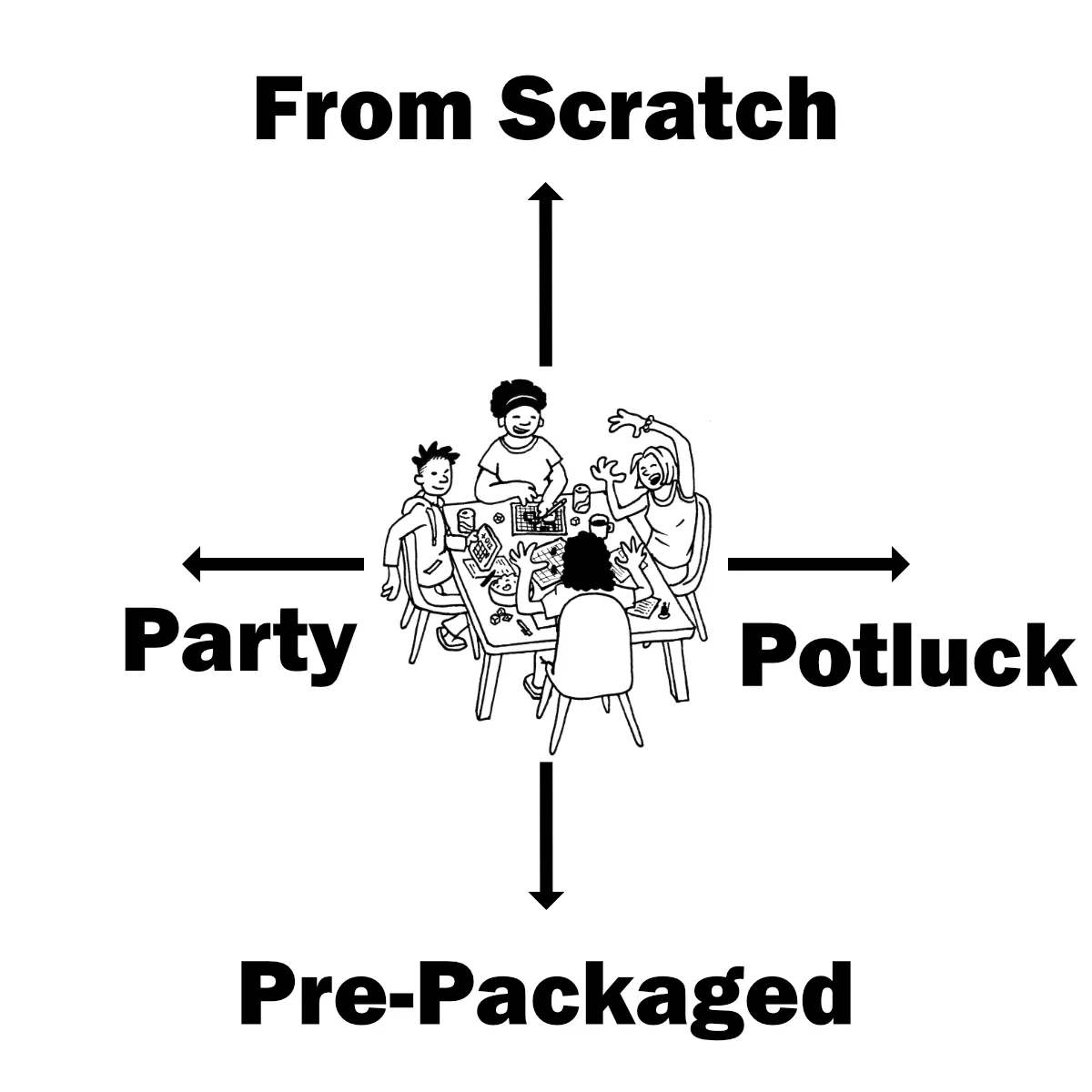
Picture of people doing the thing you wish you were doing instead of reading this blog by Emiel Boven, CC-BY 4.0
Introduction
So I've been talking about Play Style Preferences lately, which is good to talk about just so one can figure out if their play culture aligns closely enough with the play culture of everyone else in the game. There are lots of models for having this conversation, whether its Skullboy's RPG Preferences Matrix, the Three Question Taxonomy, or Close and Distant Playstyles.
However, the more I think about it and talk about it with friends, the more it seems like there are more practical considerations beyond play culture that can determine whether a group is ultimately cohesive. I can often play in groups that have variances in their play style preferences compared to my own, but I have a hard time when we are not aligned enough in the particular categories I am about to talk about.
There are two fundamental axes (as in the plural of axis) that people should consider when it comes to establishing and maintaining a TTRPG gaming table. Where you fall on these axes essentially determines your alignment. Just like a fictional party of adventurers will disband if there are too many conflicting alignments, so too will a TTRPG table become dysfunctional if not enough participants are aligned.
So lets talk about Table Alignment.
Taking Inspiration From The Dinner Table
To me, there is no better metaphor for how to look at this particular aspect of TTRPG group dynamics than having a communal meal together. Like the categories they are named for, there is nothing inherently wrong with any of these approaches so long as everyone has clear expectations regarding what is expected of them.
Axis #1: Party versus Potluck
When you are invited to a party, you generally don't have to worry about much beyond showing up with the correct attire, perhaps a small gift, and not embarrassing yourself by sticking your elbow in the punch bowl. If you are the host, on the other hand, you are responsible for organizing the menu, having the meal prepared, providing any necessary entertainment, and the clean-up after everyone leaves.
So the Party category is the same for a TTRPG game table: the person running the game is responsible for planning out the scenario, taking all of the notes, providing cool handouts, making sure everyone has a good time, and then prepping so they can do it all over again the next time the table meets. They might even literally be hosting and providing food and beverage like an actual party.
If you are a player at a table where the GM is expected to take on this level of responsibility, what you are responsible for is remarkably similar to that of a party guest: Show up when you are supposed to and not put your elbow in the punch bowl (fail to know the rules and be unready to play).
On the other end of the axis is the potluck, where everyone who attends the gathering brings a dish to share. You can coordinate them or let everyone bring their favorite thing, though the latter risks a really uneven culinary experience. Often potlucks are community events, or happen at very large family gatherings, and responsibilities are shared amongst all attendees. Someone might host and make a dish, while someone else might bring utensils and a dish, ice, help with clean-up, etc.
Now, Potlucks as a TTRPG Table Alignment category can be seen in GM-less (or GM-full) games where everyone at the table takes on some aspect of the GM's responsibility, but a traditional structure with one GM and the rest of the participants being players can also have a Potluck approach. There are a lot of little things that can be taken on by players to alleviate some of the burden of the GM: one player can be responsible for taking notes and doing session recaps, an artistically inclined player might map or draw visual references, another may be responsible for snacks and clean-up, etc. The traditional roles of Caller and Quartermaster in Old School D&D circles are great examples of things that alleviate some of the burden of GMing and they can apply to other games as well.
Axis #1 Pros and Cons
The benefit of a Party approach is consistency and coherence. The success or failure of the night is primarily determined by the GM and they don't have to trust that everyone else will do an assigned job well. They don't have to worry about the party Chronicler forgetting to note a crucial detail or if the Quartermaster correctly noted the contents of the treasure hoard the party uncovered midway through the session.
The main downside of the Party approach is that it can be a burden on the time and energy of the GM. When you consider a group of peers, parties only make sense if there is reciprocity. If the same person is expected to host parties again and again, without any help from other attendees, this can become a source of resentment in families and among friend groups. The same can apply at a TTRPG Table. After all, is it really fair to ask someone to consistently do all of the work without pitching in?
The benefit of a Potluck approach is that the work of maintaining a regular gaming night is distributed amongst all involved and everyone has a bit more skin in the game. The GM can focus on what they find the most fun and delegate some of the responsibilities that they don't care for to the players.
The downside of a Potluck approach is that if things aren't done properly you might not know until it is too late. A GM firmly aligned on the Party side of things knows when they are too tired, had inadequate time to prepare, or are otherwise unable to carry out their responsibilities. Just like when the person who was responsible for bringing the main course only brings enough for half the attendees, a person who didn't do the recap or didn't go through the shopping and downtime procedures that the rest of the players did has suddenly caused your session to grind to a halt.
That's where the second axis comes in.
Axis #2: From Scratch Versus Pre-Packaged
Some meals are prepared over the course of several hours, starting from fresh ingredients, often following recipes that have been honed by many preparations over the course of years.
So one end of this axis is what I call the From Scratch approach, which can be characterized by carrying out the responsibilities of the TTRPG Table with extreme dedication. These are the GMs that spend hours constructing Sandboxes full of bespoke Dungeons, Factions, and Wilderness Encounters. These are the players that take detailed notes and provide complete session reports that both GM and Players can reference between sessions for planning purposes. These are the players that handle logistical shopping and downtime on their own time when asked, seeking clarification from the GM outside of the session time so as not to waste precious game time.
Sometimes you don't want to bother with all the labor involved with cooking things from scratch, though. You stop at the grocery store or swing by the drive-thru on your way to the engagement. This isn't meant to be taken as a value judgment. You might judge your cousin for showing up to the family potluck with store-bought Mac and Cheese, but if they have a newborn or are working three jobs you tend to be a lot more forgiving of this sort of thing.
The other side of the axis is the Pre-Packaged approach, and this represents participants that either don't have the time or inclination to spend much time on TTRPGs except for when they are literally at the table. If you are a GM, this might mean leaning heavily on purchased modules, procedural generation, and one-shots. If you are a player, it might mean you show up ready to play but are loath to do anything you might think of as "homework."
Axis #2 Pros and Cons
The benefit of participants taking a From Scratch approach is that they tend to make really good players and GMs because they put so much time and energy into it. Like anything in life, putting the work in tends to make you good at it. I have seen Megadungeon games where people spend time plotting downtime moves, strategizing about what to do between sessions, etc. This dedication allowed a level of gameplay that wouldn't be possible if people didn't think about the game between sessions.
The downside of the From Scratch approach is that it can be unsustainable, especially if life circumstances change. It's pretty easy to refuse to accept your new reality and then burn out as a result. It can also cause a lot of friction if a small number of players or the GM want to approach things From Scratch but everyone else is unwilling or unable to.
The benefit of the Pre-Packaged approach is that you can maintain your level of commitment pretty easily as long as you just show up to the gathering in question. If you are a GM, you're main cost is in actual money buying modules rather than time spent laboring over bespoke content.
The downside of the Pre-Packaged approach is that it can let people down if their expectations aren't properly calibrated. If you expect your GM to run this glorious years-long campaign and they keep running one-shots you are bound to be disappointed. Meanwhile, if you are a GM expecting your players to get invested in the world and its secrets and they can't be bothered to keep track of what happened from session to session, that can be a source of frustration.
Determining your Perfect TTRPG Table Alignment.
I'm sorry to say that this schema doesn't allow you to scientifically determine the ideal composition of your table participants. You can't just say, "I'm Potluck and From Scratch, so I need 4 other people who are also Potluck and From Scratch." Well, you could, but I think the odds of you bringing together a group with your perfect set of sensibilities is a little bit of a pipe dream.
This is further complicated by the fact that people's alignment will likely shift over time as life circumstances change. I tend to be very "From Scratch" as both a player and GM, but work and family responsibilities have lately pushed my contributions closer to "Pre-Packaged" side of things.
I think it is better to examine everyone's tendencies upfront and figure out how to align them as best you can, making adjustments as circumstances change. If you are a GM who is used to taking the Party approach, but you find it unsustainable due to time or inclination, talk to your table about taking a Potluck approach. Tell the players what additional responsibilities you could use help with and see what everyone is willing to do. If you have a player that really favors the Pre-Packaged approach and doesn't want to take on additional responsibilities, the group needs to decide if they are willing to pick up the slack or not. If it is due to life circumstances like holding down a stressful job or having a newborn, you as a table might decide you are okay with this. However, if they just want to take a more casual approach to gaming compared to the rest of the group, it might be best if you parted ways if this will cause too much tension amongst the group.
This isn't like your yearly family gathering where your brother always does the bare minimum and you grumble about it and move on. These are people you are going to be seeing on a regular basis. Everyone needs to have a clear understanding of what their role is supporting the table. You just can't give everyone the same role, like in GM-less or GM-ful games, and hope for the best. If two out of the five players are taking From Scratch approaches and the rest are going Pre-Packaged that is bound to lead to some resentment.
Compromise will inevitably have to occur. If everyone takes on additional roles because of a Potluck approach, but someone is not good at something at first then people will need to be patient with them. Or switch roles. Or put them in charge of snacks. We all have that one friend or relative that we put in charge of getting ice because we don't trust them to do anything else. Sometimes, the GM will need to not be such a control freak and trust that people can keep track of torches and write play reports and things will occasionally be missed.
Once again, I want to stress that it's not that certain approaches are inherently superior, but the wrong set of them can definitely cause issues. If everyone at the table is okay with Party and Pre-Packaged then that sounds like a really good beer and pretzels D&D group, but if the GM wants Potluck and From Scratch and his players all want Party and Pre-Packaged that is a recipe for disaster. Believe me, I speak from experience.
So before you determine your character creation preferences or if you like Gonzo or Grounded, before you decide if you are there to solve problems or tell a good story, even before you decide the number of GMs, figure out what each person is bringing to the table. Because all types of meals are acceptable as long as all parties agree to it.