Play Style Preferences: Character Cultivation, Not Character Builds
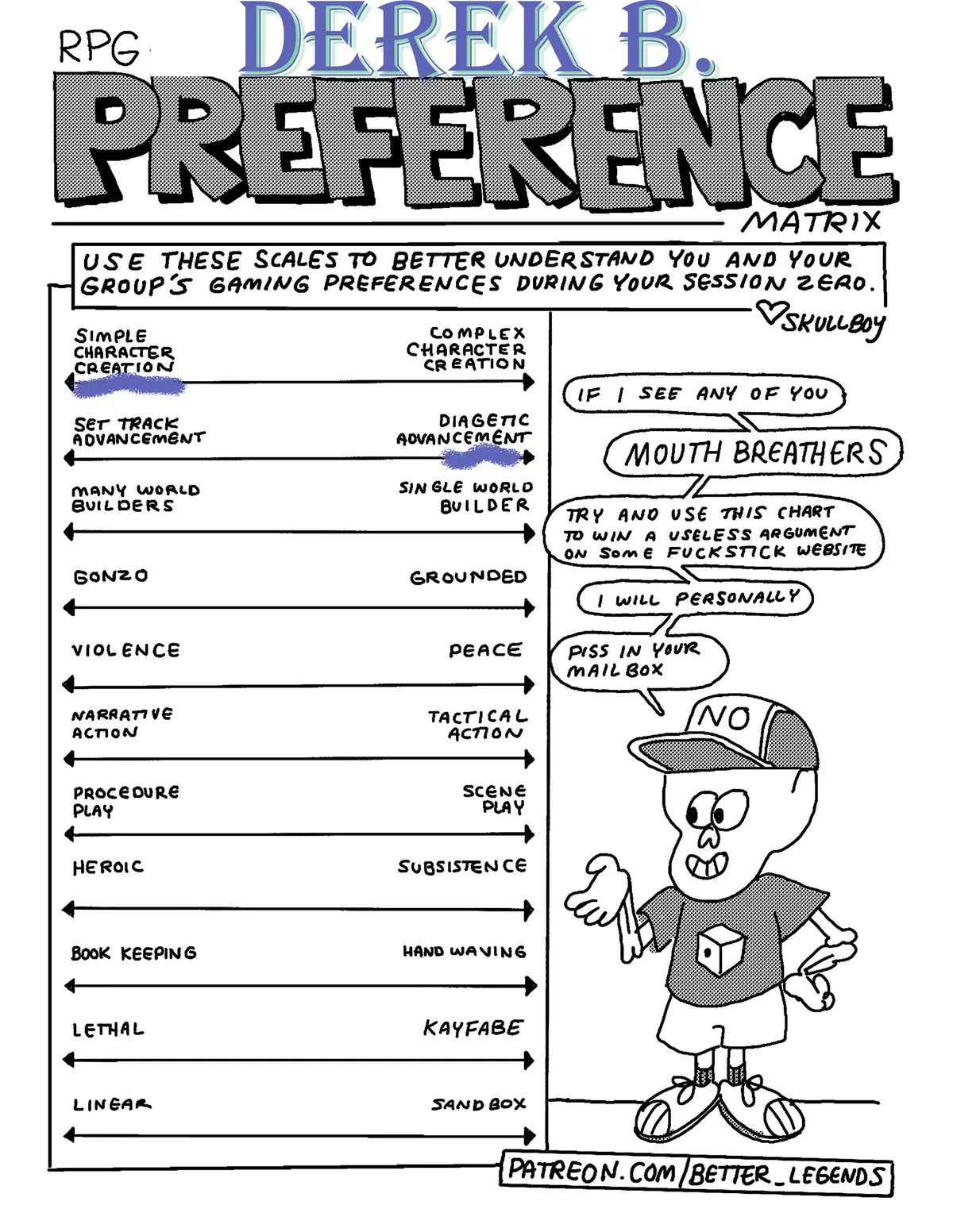
Original image by Better Legends. Used with permission.
Introduction
I'm back again, Gentle Reader, this time to tackle the scale on the RPG Preferences Matrix that has to do with advancement. This is a more difficult category than the last, because Set Track and Diegetic are open to interpretation. And so, in an effort to prevent misunderstandings and dreaded Discourse, I will start with a definition of terms.
What is "Set Track" Advancement?
I interpret Set Track advancement as relating to your more traditional character progression: You fulfill a certain requirement, like pulling enough gold out of a Dungeon or killing enough monsters or hit enough story milestones, and once you hit that preset amount of XP your character advances. This might mean they become slightly better at combat, gain access to new spells, or become more skilled at a number of tasks. Whether they have a choice in what these advancements are or not, the key for me is that they are not directly tied to play. There is an intermediary in the form of XP for GP, XP for monsters slain, or story milestones.
This has been the status quo for Fantasy Adventure Games since the beginning, really. What has typically changed over time, both with new editions and new games, is the amount of choice one has during the advancement process. Even games that tend to uphold random character creation tend to relinquish more control to the player when they mechanically change. Advancement in many of these games is treated like shopping at the marketplace with a menu of character abilities in lieu of Rations or Platemail. This possibility can lead to players actually planning out the entirety of their character's advancement before they have seen a single session of play. This is often called a Character Build, as I’m sure basically everyone knows.
As you might suspect from my earlier post on the benefits of random character creation, I am not partial to this approach at the present.
Di-uh-what?
Diegetic, on the other hand, is one of those terms that was really popular in the blogosphere for a while. In its original context, it refers to whether a sound in a movie or TV show is happening in-world or if it exists only for the audience, e.g. a musical score. In RPG circles, something being Diegetic means that it is grounded in the fictional reality of the setting.
Therefore Diegetic Advancement is character growth that has both a mechanical and fictional element that is present during play: e.g. if you find a sword master and train with them you might master one of their techniques. Some people lump Milestone leveling in with this, where characters level up and/or advance based on hitting certain story beats within a campaign, but I would like to stress that this is not what I mean when I, personally, discuss Diegetic Advancement. For me, Diegetic Advancement is about making sure that your character changes in a way directly related to the actions they are taking in the fiction of the world.
But what does Diegetic Advancement look like in play and how do you make it not feel like leveling with extra steps? After all, if I have to find a swordmaster and pay him 2000 GP to become stronger, isn't that just leveling with a Diegetic coat of paint?
For me, the key to this approach is to look at Advancement not through the lens of Character Builds, but Character Cultivation.
Character Advancement: Architect Versus Gardener
There is a dichotomy between writers that I first saw articulated by George R.R. Martin of A Song of Ice and Fire fame. Some writers are architects, carefully planning out character and story beats and having a foundation of a story laid down in outline form before they first sit down to write the actual prose of their book. Others are Gardeners, taking an initial concept or a handful of characters and setting details and slowly nurturing and cultivating their initial seed of a concept into a fully-grown and flowering story.
What does this have to do with playing a TTRPG? Well, I think a lot of games lend themselves to Player As Architect, where you can plan out a Character Build that provides the exact mechanical path of advancement that your character is going to take ahead of time. When you couple that with the desire to plot out the path of story advancement, you get multiple pages of backstory and a pretty firm understanding of where your player will be at the various stages of a campaign.
For my purposes, though, I prefer Player As Gardener: you can't change your initial equipment or attributes in the same way you can't change the climate your garden is in. You don't know whether your character will survive any more than the gardener knows if their flowers will survive the first freeze of the year, so you don't focus on who the character was or who you want them to be as much as finding out who they are by playing them.
But gardens need seeds for the right sorts of things to grow, so you as the GM/Warden need to leave some scattered about for PCs to find and cultivate.
Planting the Seeds of Diegetic Advancement
If you want players to pursue Diegetic Advancement it works best if you consider potential avenues of growth and scatter those throughout your sandbox before your game even begins. The best advice that I have ever found on how to do this was written by Ben L. in Downtime in Zyan, specifically “Downtime As Worldbuilding”. If you aren’t familiar, it is a series of prompts that you can use to create things in your setting that PCs can act on: organizations they can work for and learn secret knowledge or powerful techniques, master artisans in the area, past examples of such things that have left legacies that the PCs can uncover, etc. I don’t follow the advice to the letter because I’m just as interested in Foreground Growth as Downtime, but it is a great starting point.
The important thing is not to spend too much time figuring out things like mechanical details or setting details: These seeds may never sprout.
Baiting Hooks
Yes, I know I’m mixing metaphors here, but sometimes common terminology is useful.
Rumors, patrons with potential jobs, encounters on your Regional Encounter Table, etc. These are always important in a sandbox setting, but juicy hooks are doing double-duty when players can't just gather up something generic like GP or combat XP and receive a guaranteed form of advancement.
Sometimes a game system will do some of this heavy lifting for you. Cairn 2e has things like Bonds and Omens that can give characters potential avenues of exploration and growth straight from the jump. If you’ve ever wondered why they are so vague, that is why: they are malleable by design so that you can use them as hooks for the various content that exists in your sandbox.
After you’ve baited all of your hooks, it’s the job of the players to pursue the things that interest their PCs and take advantage of the opportunities that they encounter along the way.
Cultivation
This is the hard part. You have to really pay attention to what your players are doing. You should be doing that anyway, because one of the best things about TTRPGS is how players can have so much of an impact on the world around them compared to other types of games. I’m not the only one who thinks so. The difference is that you’re not just looking for things like “the cultists are going to seek revenge for the defiling of their altar” or “the Reeve will remember how you saved the town in its time of need”. You’re looking for things that characters are doing, things they are experiencing, that might result in them permanently changing.
If you’ve done your job, you should have a sandbox full of interesting people, things, and creatures that your PCs can bump up against: either because they are a direct goal, an obstacle in the way of said goal, or through the happenstance of exploration. Players will interact with the world, cultivating some of the seeds you planted and letting others lie fallow. That is fine. This is why you didn’t waste time developing any of them beyond the fictional layer.
There are two primary ways that a player can cultivate their character using this approach to advancement: Foreground Growth and Downtime.
Foreground Growth
Growth is the idea that characters are changed directly from their experiences in play. The concept was popularized by Chris McDowall of Bastionland fame, and his framing of it as Foreground Growth is key to understanding the approach: Primacy is placed on play, not pre or post-game activities. His methods are good, though not the only tools in my Diegetic tool-belt.
I always treat things that happen in play as the most important thing, so at my tables Foreground Growth is the fastest way to cultivate your character. Someone who repeatedly makes DEX Saves to be stealthy is going to see Growth related to that far faster than someone who has been training with a master thief between sessions. It’s also a really good way to end up dead. You know what they say: no guts, no glory.
Sometimes these cultivation opportunities come as a result of the seeds you planted before your campaign began, but a lot of time they will become emergent through an unexpected confluence of the situation at hand and what resources PCs bring to bear.
But you can’t always do stuff during play, right? After all, no one is going to sit around for an hour while one character roleplays a training session with the swordmaster they befriended. That’s where Downtime comes in.
Downtime: Background Growth
Downtime is a way to cultivate your character without consuming precious hours of session time by hogging the spotlight. You can research at that library you just got access to by befriending a certain Faction, train with the master woodsman you rescued from trolls two sessions ago, etc. This is all stuff that your character might also theoretically be doing on a fictional level in a Set Track advancement game, it’s just that there the whole process is usually elided. For my tastes, I want Downtime to reflect what is happening during play. In Cairn 2e, Yochai talked about Sources when discussing researching things during downtime.
A Source is a person, place, faction, or entity that holds either a part or whole answer that the character seeks. They can be NPCs, Factions, spirits, or even other PCs.
As an example, a player whose character rolled the Stone Heart Bond once used a PC that was knowledgeable about such things as a Source to track down a lead on how they might be cured of the affliction.
The thing is, every Downtime action potentially has a Source involved, and the best ones are often the seeds you took the time to plant before your campaign began. A remote swordmaster that you have befriended is a much better Source than the local guardsman you can pay for lessons when they are off-duty, though both are better than the local drunkard who will teach you dimly-remembered forms from his time as a conscript in exchange for a couple of tankards of ale.
The Cycle of Cultivation
This essentially becomes a feedback loop. PCs pursue hooks they are interested in, experience Growth based on how they interact with the world and the risks they take in pursuit of their objectives, can capitalize on their actions during play by cultivating any seeds they uncover during Downtime, which then leads to them continuing their pursuit of an existing goal or taking up a new one that could lead to further cultivation.
Examples of Cultivation
A lot of people get nervous about coming up with actual mechanical changes that result from Growth or Downtime. I understand the sentiment, but at the end of the day you are likely to have played many systems that have provided you a model for what these can look like. For Cairn 2e, it’s useful to look at some of the abilities that certain Background table results impart, Scars, and the already existent examples in the Growth Chapter of the Warden’s Guide.
However, I think it is a mistake to only count a character changing mechanically as Diegetic Advancement. Obtaining a new Spellbook is Diegetic Advancement, as is making inroads with a major Faction or obtaining a base of operations from which to launch new expeditions. These party-focused forms of advancement are often better in OSR games because they generally survive the death of a single individual.
Regardless of the type, what really matters is that the changes that PCs experience are a direct result of their interaction with the fictional world, not simply as a result of reaching an arbitrary number of GP/XP/Milestones or what have you.
Potential Pitfalls
As this post title indicates, this approach is my preference and I’m not holding it up as an objectively better way to play. I also won’t pretend it isn’t harder than the traditional Set Track way because it absolutely can be depending on your comfort level with sandbox play, making rulings, and individual systems mastery.
That said, there are some things I see people do and discuss that I think are mistakes when taking this approach and I want to take the opportunity to highlight those and explain my reasoning.
1. No Guarantees
Most people when playing adventure games will not assume they will find a particular type of treasure, such as a Bag of Holding or Vorpal Sword. Even if one encounters a particular magic item, most players understand that they might not end up possessing said item. The potential perils too great. The competition amongst the party too fierce.
For me, this same mindset should apply to Diegetic Advancement. If your character doesn't pray at the scary shrine, you can't be upset if the forgotten god didn't choose them. If another character already took that risk and forged that bond, you are unlikely to receive the same benefit via the same method.
No character is owed advancement. Some may take great risks and radically change as a result, while others may be more cautious and change very slowly. Of course, taking risks is also a good way to get your character killed.
Above all else, please don’t feel like you have to trigger Diegetic Advancement in one PC just because another PC experiences it, or that you have to come up with individualized plans for each PC. Growth and Downtime are player responsibilities. The GM’s role is but to facilitate.
2. Rumors, Not Rewards
My hatred for shopping is already well-established, and so I will not pretend that my advice isn’t biased here, but I don’t think you should tell players the mechanical benefits of the things they are pursuing. Fictional explanations are fine, but mechanical changes are best left to be revealed once obtained.
Why? Mostly because I think rumors are more interesting than rewards. A bespoke magic item you find in a dragon’s hoard is a lot cooler than a character ability listed in your player’s guide. This is why the Spellbooks in Cairn 2e are in the Warden’s Guide: there’s nothing less magical than a player poring over a list of spells to find the perfect one to attempt to track down.
3. Table Temperament
My final and most important pitfall to cover is the hardest one to swallow: This won't work for every table. Sometimes players bounce off sandbox play. A lot of digital ink has been spilled trying to remedy that, but some players want to go with the flow and not have the level of agency that a good sandbox provides players. Diegetic Advancement is like stocking your sandbox with a bunch of hidden locations, or your dungeon with secret rooms and magic items: even a diligent party will miss cool opportunities, and a more casual group might end up having a bad time. Players will need to be engaged, follow leads, and take risks in order to really benefit from this approach. A more casual player can be accommodated, but they won’t get the same experience out of it as a more engaged player and they have to be okay with that.
If most of your players are the type to only think about the game during the game session, don’t show much investment in the setting, and mostly want to kill things and take their stuff, I cannot stress enough that this will not work. There’s nothing wrong with playing that way, to be clear, it’s just incompatible with this particular approach.
Conclusion
So there you have it. This is my preference when playing and running games. It’s not for everybody, but I think there’s real value to the approach if you want to run a campaign using a system that doesn’t have traditional advancement methods.
What is your preference for your tables?