Play Style Preferences: Lightning Round and Conclusions
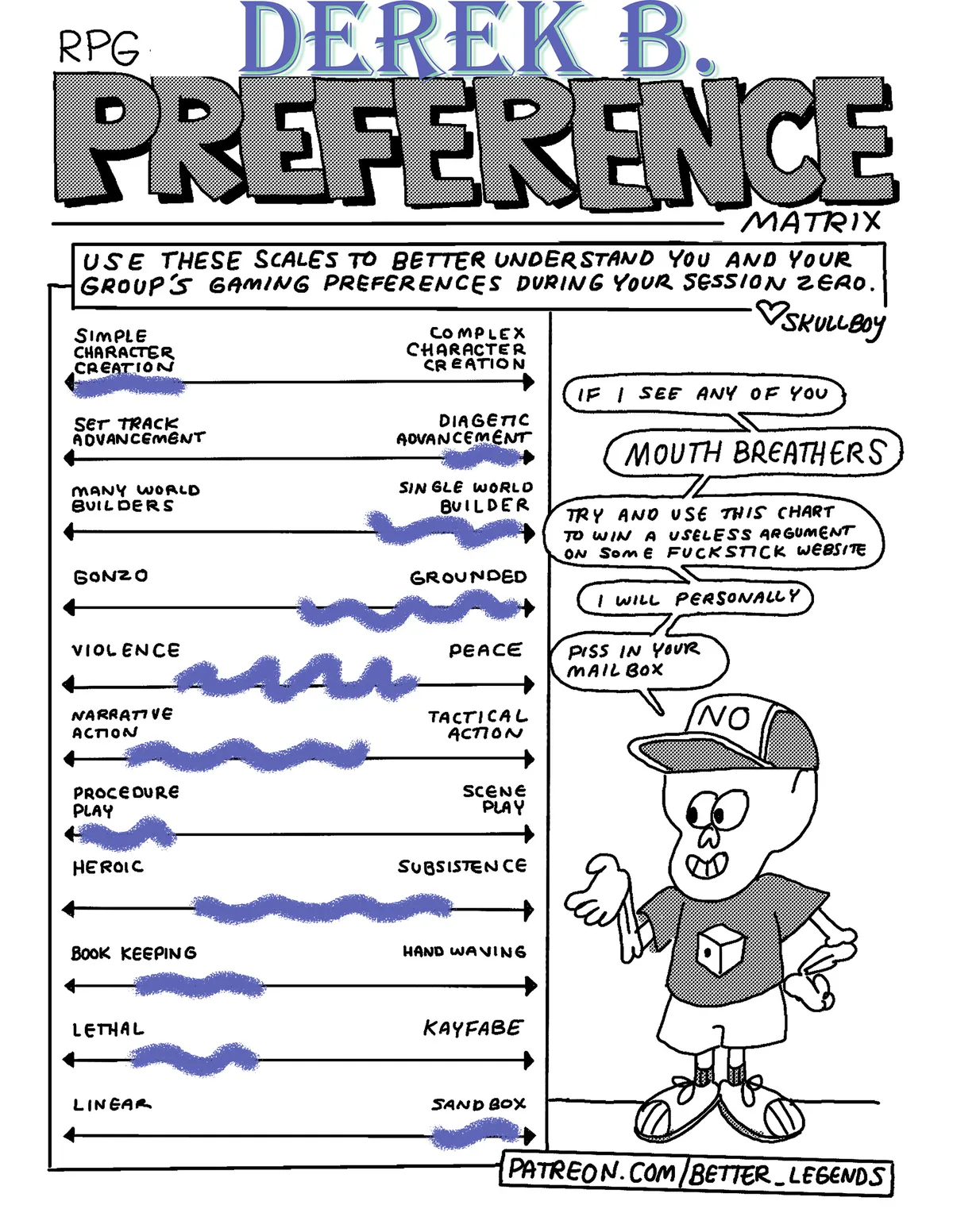
Original image by Better Legends. Used with permission.
Introduction
There's been a lot of play style discourse lately, some of it contentious, and that has inspired me to revive my neglected Play Style Preferences series.
I've let it lay fallow for a while not because I don't have enough to say on the various other categories on the matrix, but because I have too much to say. One of my goals with this series was to keep my posts very short by my standards, but attempting brevity in blog posts often results in me staying my hand.
But Seraphina posted a nice little manifesto about writing short blog posts, which reminded me of Ram's post about microblogging. So here's what I'm going to do. I'm going to write a paragraph for each of the remaining categories.
Let's start the lightning round!
Violence and Peace
I am paradoxical as a player in that I like to have the option to solve things nonviolently but am very likely to resort to it if it is expedient and can be justified by my character's likely stunted sense of morality. A lot of intelligent dangers in Dungeons are just nails of various size. It can be fun to hit nails with hammers, and avoid particularly large nails until you have a big enough hammer for them, but my favorite enemies and Factions have qualities that make you hesitate before reaching for the hammer. Things are more interesting when violence doesn't always simplify matters.
Narrative and Tactical
I don't enjoy battle maps and do not relish counting squares to determine how far I can move in a given Round or Turn or whatever. That said, I do like exploring environments that are clearly defined spaces with contents that I can exploit. I like determining Marching Order, bringing the right resources to bear for a given threat, etc. I think you can run a very tactical game that doesn't rely on minis, battle maps, or precisely measuring the size of an area of effect spell.
Procedure Play and Scene Play
I strongly prefer procedures shaping the course of play than considering things from a Scene perspective. I will not argue that Scene play isn't beneficial for many play styles, or that some genres lend themselves more to scene play than procedure play, but I strongly prefer the stories that result from good procedures that support the type of game I am playing both as a player and GM, both due to the surprises that result from such rules structures as well as the way they allow the dice to be the arbiter of the direction a session goes in a way that preserves the neutrality of the GM in especially challenging situations.
Heroic and Subsistence
I feel like this is a loaded category for me because Heroic means so many things to so many people. I see this category largely as the types of activities you concern yourself with within a game. Honestly, I've never been too much for incredibly gritty realism in games where I have to make a living doing shit jobs, have a chance of dying of sepsis, etc. If my character dies, I'd prefer it to be due to a poor decision I made when faced with a fantastical source of danger in a dungeon, not because I failed a roll and my wound got infected. I like the option to be a hero, but I prefer it to be hard, have a real chance of failure, and actually require some sacrifice. I don't find heroism as an expected mode of play very compelling.
Book Keeping and Hand Waving
I am big on what resources you have on hand mattering, and I like the tension that is created and the potential for hasty decisions being made as a result of the threat of resource depletion, but I honestly find a lot of traditional OSR games and systems don't get the job done for me. It is trivially easy to pack enough light sources for dungeon delves in many systems, and the economies of many Adventure Games begin to break down after a few big scores when it comes to most expendable resources. I think limited inventory space and some variation of the overloaded encounter die can produce tension in a way that counting duration in 10-minute increments fails to deliver in my experience, but the tyranny of tedious shopping trips is not entirely a solved problem. However, I do think games like His Majesty the Worm and Stonetop have interesting lessons to teach us that could be applied to many other adventure games.
Lethal and Kayfabe
I hear a lot of chatter about one of the defining features of OSR games being lethality. I've been playing in and running OSR games for quite some time now, and I will say that in my experience characters die very rarely and often as a result of a risk that ultimately didn't work out. I do think there is a subset of the OSR that don't mind random, untelegraphed dangers that can kill characters, but such things typically leave a bad taste in my mouth. I think of it as Slot Machine D&D, and consider it a design practice best relegated to Tournament Modules and perhaps Funnels. What I really want to see is Impact from my decisions, both positive and negative, and death is merely one of many ways that can manifest at the table.
Linear and Sandbox
I will never not want the Sandbox. The most interesting thing about TTRPGs, for me personally, is the agency to do largely what I want within the confines of the fictional reality my character finds themselves in. This doesn't mean I am opposed to "hard framing" the beginning of a session to where PCs are in front of the dungeon if that's what the one-shot is about, but I do prefer to have a lot of freedom in how my character approaches a situation once the game is underway. I have never managed to produce the perfect combination of system and setting that I envision as the perfect Sandbox campaign for my tastes, and perhaps I never will, but the attempts are satisfying enough to keep me trying.
Conclusion
I first started this series because Sam's RPG Preference Matrix really resonated with me. I have run into issues with tables that I have both run and played in where we didn't clearly identify our preferences and it caused friction and contributed to the dissolution of the group. Though I mostly play OSR games, I have strong preferences that differ from many other people who exist within the play style. I think its important to talk about these things. After all, you don't have to play games associated with the OSR in an OSR fashion. You can't just assume that everyone is going to be on the same page.
So there you have it. My RPG Play Style Preferences. A system and table don't have to be precisely aligned to my own preferences, but the more they are the more likely I am to have a good time. I think it also goes without saying that any table I am in charge of is going to prioritize these preferences over others.
Not because my play style is objectively better than your own, but because I think people should make and run the types of TTRPG material they want to see in the world.